
‘The New Era of Hypnosis’
For decades, stage hypnosis had been treated like a parlour trick, living in the shadow of its own clichés. Something dusty and theatrical, buried beneath swinging pocket watches, exaggerated accents shouting commands and volunteers made to cluck like chickens, had shaped public perception of hypnosis as little more than a novelty act.
Audiences laughed, sceptics scoffed and performers leaned into spectacle rather than substance. But something essential was lost: trust, dignity and a genuine understanding of what hypnosis truly is.
For much of its public life, hypnosis existed behind a curtain of misunderstanding. It was framed as something theatrical and faintly ridiculous. The hypnotist stood as a figure of authority, the audience laughed and the volunteers surrendered their dignity for entertainment. Beneath the applause, hypnosis was quietly reduced to caricature.
That wasn’t the world Poldark stepped into when he first walked onto a dimly lit stage in a small seaside theatre. Not with booming authority, but with stillness, clarity and a radical idea: hypnosis is not about control; it’s about cooperation.
He did not arrive announcing revelation. There were no bold claims, no dramatic entrances, no attempt to shock the tradition into submission. Instead, he did something far more disruptive: he changed the relationship between hypnotist, subject and audience.
Poldark believed hypnosis had entered a new era, one not built on control, but on collaboration. He often said that hypnosis wasn’t something done to people, it was something people did with themselves, if given the right conditions. His shows were designed not to overpower the mind, but to invite it forward and in doing so, he marked the beginning of a new era of stage hypnosis. That philosophy would change everything.
Breaking Away from the Old Model
Traditional stage hypnosis thrived on spectacle. The hypnotist was the dominant figure, the audience passive observers and the volunteers often the butt of the joke. While entertaining, this approach reinforced the myth that hypnosis involved surrendering control.
Poldark challenged this assumption at its core.
From the beginning, he openly explained hypnosis rather than hiding it behind mystery. He spoke about attention, imagination and focus; natural mental states that everyone experiences daily. By doing so, he disarmed scepticism before it could take root.
That single shift in language changed the atmosphere of his performances.
A Different Kind of Stage Presence
Night after night, the audience arrived expecting comedy. They had seen stage hypnotists before; volunteers clucking like chickens, forgetting their names and falling over in laughter. Poldark’s name on the poster meant little to them.
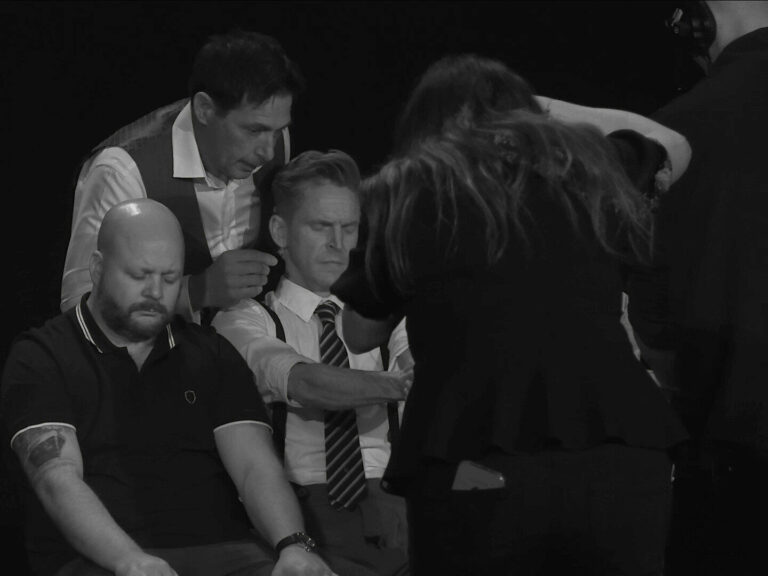
The stage was relatively bare; just a row of chairs, soft lighting and a haze of smoke. Poldark walked out slowly, the absence of spectacle was striking. Scanning the room not with intensity, but curiosity.
No exaggerated gestures, just a calm presence and a voice that invited rather than commanded.
“Tonight,” he said, “nothing will happen to you. Everything will happen for you. Nobody will be asked to do anything remotely embarrassing.” Some laughed nervously.
He invited volunteers, but with an unusual condition; “Only come up if you want to experience something real. Do not come up to challenge me.” That filtered the crowd more effectively than any rapid induction ever could.
Volunteers were not chosen for their suggestibility alone, but for their willingness to explore.
Instead of rushing into inductions, he took time to engage both the volunteers and the audience. He spoke to them as intelligent participants, not subjects. He explained attention, imagination and how the brain naturally slips into focused states every day, while driving, daydreaming or reading a story.
As he spoke, something subtle happened. The room quietened. People leaned forward without realising it.
Poldark guided the volunteers through breathing, not as a command but as a suggestion. He described sensations rather than ordering responses. His words painted images with warmth in the hands, heaviness in the legs and clarity in the mind.
The trance arrived without force. Even the sceptics felt it. This created something rare in live entertainment: collective trust.
The result was deeper, more authentic hypnotic experiences that resonated beyond the stage.

Entertainment Without Humiliation
What exactly defined this new era of hypnosis?
Perhaps the most defining aspect of Poldark’s work was what he refused to do:
– He refused to embarrass volunteers.
– He refused to reduce hypnosis to ridicule.
– He refused to treat people as props.
Poldark’s shows evolved into immersive experiences blending psychology, storytelling and live demonstration. Each performance became a shared journey, one where audiences learned something not just about hypnosis, but about themselves.
No volunteers were made ridiculous for the sake of laughter. No stripping away of dignity. No sense that hypnosis required embarrassment to be effective or entertaining. Instead, volunteers experienced heightened confidence, freedom from stress, vivid imagination and emotional clarity, not because they were commanded to, but because they allowed themselves to.
Audience members didn’t just laugh, they reflected, watching closely, recognising something unsettling and empowering at once: the hypnotic state was not exotic or rare. It was human. Many recognised aspects of themselves in what they witnessed.
The entertainment that arose was from recognition, from watching ordinary people access extraordinary focus and emotional depth. The laughter was warm, not cruel. The applause came not from mockery, but from respect.
The audience wasn’t just entertained, they were transformed witnesses. By the end of the show, the applause wasn’t loud at first. It came slowly, like realisation spreading through the room. People left quietly, talking in low voices, as if they didn’t want to break something fragile and new.
Hypnosis Re-imagined
Poldark’s performances evolved into shared experiences; part demonstration, part reflection, part quiet awakening. Each show suggested the same truth: the mind is not fragile, nor easily controlled. It is adaptive, imaginative and far more capable than most people are taught to believe. They evolved into experiences that blended storytelling, psychology and deep human connection.
He believed the theatre was where transformation could be shared collectively; where people could see, in real time, what the human mind was capable of when treated with respect. However, the impact of Poldark’s work extended far beyond theatres, into therapy rooms and clinics. Yet despite this broader influence, Poldark remained committed to live performance.
At the heart of Poldark’s work was a fundamental belief: hypnosis is not something imposed upon the mind. It is something the mind participates in willingly.
This stood in direct opposition to the prevailing myth, that hypnosis required surrender, that it involved a loss of control. Poldark dismantled that idea not through argument, but demonstration.
The New Era had Begun
The new era of hypnosis was not defined by technique alone, but by philosophy. Hypnosis became less about spectacle and more about possibility. Hypnosis was no longer something to fear or mock, it became something to explore.
It was seen as a natural extension of human attention and imagination, not a supernatural power wielded by a performer. The hypnotist became a guide rather than a controller. This approach proved that hypnosis could be entertaining, ethical and emotionally impactful all at once and it became something audiences could imagine experiencing themselves, without fear of mockery and dominance. It wasn’t about control. It was about choice.
The greatest revelation of the new era of hypnosis is this, the mind was never powerless. It simply needed permission to realise its own potential.
And Poldark? He continues as he always has:
– He still walks onto relatively bare stages.
– He still speaks softly, without urgency.
– He still trusts the intelligence of the audience.
Because he knows the greatest trance wasn’t created by a hypnotist, it was created the moment someone realised their mind was far more powerful than they’d ever been told and because the ultimate lesson of the new era of hypnosis was never about trance at all.
Explore Hypnosis
Experience Hypnotic Bliss
Discover the magic of hypnosis. Our performances not only entertain but also delve into the wonders of the mind. Join us for an experience you won’t forget.